


 Cart
Cart
 sales@molnova.com



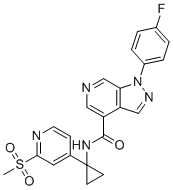
BI 639667
CAS No. 1295298-26-8
BI 639667( BI639667 | BI-639667 )
Catalog No. M11194 CAS No. 1295298-26-8
BI 639667 (BI639667) is a potent and selective antagonist of human CCR1 with binding IC50 of 5.4 nM.
Purity : >98% (HPLC)
 COA
Datasheet
HNMR
HPLC
MSDS
Handing Instructions
COA
Datasheet
HNMR
HPLC
MSDS
Handing Instructions
| Size | Price / USD | Stock | Quantity |
| 5MG | 262 | Get Quote |


|
| 50MG | 1269 | Get Quote |
|
| 100MG | 1917 | Get Quote |
|
| 200MG | Get Quote | Get Quote |
|
| 500MG | Get Quote | Get Quote |
|
| 1G | Get Quote | Get Quote |
|
Biological Information
-
Product NameBI 639667
-
NoteResearch use only, not for human use.
-
Brief DescriptionBI 639667 (BI639667) is a potent and selective antagonist of human CCR1 with binding IC50 of 5.4 nM.
-
DescriptionBI 639667 (BI639667) is a potent and selective antagonist of human CCR1 with binding IC50 of 5.4 nM, inhibits chemotaxis with IC50 of 2.4 nM; shows good physico-chemical and pharmacokinetic properties.
-
In Vitro——
-
In Vivo——
-
SynonymsBI639667 | BI-639667
-
PathwayGPCR/G Protein
-
TargetChemokine Receptor
-
RecptorChemokine Receptor
-
Research Area——
-
Indication——
Chemical Information
-
CAS Number1295298-26-8
-
Formula Weight451.476
-
Molecular FormulaC22H18FN5O3S
-
Purity>98% (HPLC)
-
SolubilityIn Vitro:?DMSO : 10 mg/mL (22.15 mM)
-
SMILESO=C(C1=CN=CC2=C1C=NN2C3=CC=C(F)C=C3)NC4(C5=CC(S(=O)(C)=O)=NC=C5)CC4
-
Chemical Name1-(4-fluorophenyl)-N-(1-(2-(methylsulfonyl)pyridin-4-yl)cyclopropyl)-1H-pyrazolo[3,4-c]pyridine-4-carboxamide
Shipping & Storage Information
-
Storage(-20℃)
-
ShippingWith Ice Pack
-
Stability≥ 2 years
Reference
molnova catalog



related products
-
SCH-546738
SCH-546738 (SCH546738) is a potent, selective and non-competitive CXCR3 antagonist with binding Ki of 0.4 nM for human CXCR3.
-
C-021 dihydrochlorid...
C-021 dihydrochloride is a potent and orally bioavailable CCR4 antagonist.
-
NVP-BDZ 824
A potent, highly selective antagonist of chemokine receptor CXCR3 with binding IC50 of 146 nM, Ca2+-mobilization IC50 of 28 nM.
